The Ecosystem is Age of Intellect's operating system for a school — not a metaphor, the thing we actually build.
SCROLL ↓
What This Is
An AI interface. With a belief system built in.
Not a philosophy next to a piece of software. One object. Every screen a child
touches carries the belief system inside it — how it talks to them, what it notices and never
scores, when it hands a child back to a book or a friend instead of itself. The technology and
the ethic were engineered together, not bolted on after.
What follows names it in brief — what the AI does, what compounds in a child, Right Speech,
the Cup. The full canon
— the rituals, ikigai, the spaces, the anthem, and the founder's own spoken word — holds the rest.
Right SpeechThe CupJijang BosalIkigaiThe Buddy BenchSolo SpaceThe butterfly leaves the screenNotice, then chooseServe without a claimDifferent gifts, one familyLove, not fearRight SpeechThe CupJijang BosalIkigaiThe Buddy BenchSolo SpaceThe butterfly leaves the screenNotice, then chooseServe without a claimDifferent gifts, one familyLove, not fear
The Concrete Question
What does a child actually build, and when?
Not a curriculum scope-and-sequence. The habits and capacities that compound
year over year, so a graduating senior isn't starting from nothing.
Kindergarten
Noticing
Naming a feeling before reacting to it
Waiting a turn, asking instead of grabbing
Curiosity as the normal state, not the exception
Knowing there's a Buddy Bench and a Solo Space, and when to use each
5th Grade
Choosing
The five-gate pause before speaking, becoming automatic
Asking a real question and researching the real answer
Working in a pod where every kid took a different path
Naming what they're drawn to — the first ikigai thread
8th Grade
Reasoning
Weighing multiple sources and points of view, not one
Explaining why they chose something, not just what they chose
Serving without needing credit — Jijang Bosal as habit, not novelty
Using the interface to create, not just to consume
11th Grade
Leading
Independent research synthesized into a real artifact — a film, a podcast, a paper
Ethical reasoning under ambiguity, not a rubric with one right answer
Mentoring the younger kids who are just learning the five gates
Fluent and critical with the tool — building with it, questioning it, not just using it
Every stage compounds into the next. A senior who's been noticing
their own reactions since kindergarten doesn't need a unit on emotional regulation — they've
been practicing it for twelve years.
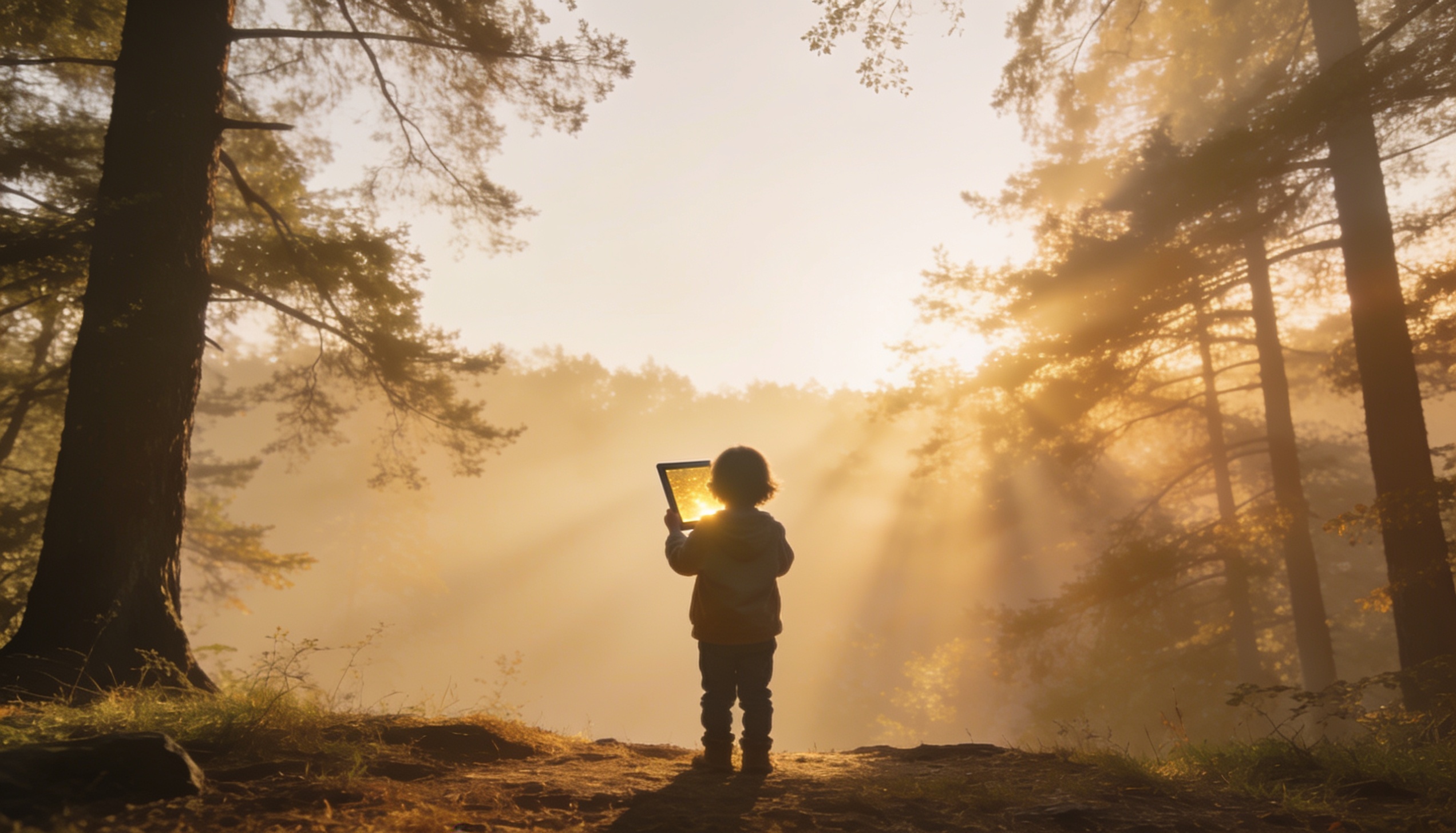
The butterfly leaves the screenWonder is the whole point — the tool exists to send a child back out into the world.
The Interface, Concretely
An AI that meets each child exactly where they are.
The philosophy is the soul. This is the body — a learning companion that
knows every child from day one and grows with them, not against them. The tech
isn't the problem. It's the solution.
1
Notice
A message about to be sent, an answer about to be submitted — the interface looks at the words before they leave the child's hands.
→
2
Reflect
It asks, gently, in the child's own words — never a rule enforced from above.
→
3
Never score it
The child chooses. Nothing is graded. The choice itself is the lesson.
Right Speech · live, on the child's screen
"delete ur account nobody wants u in the group chat"
The InterfaceBefore you send that — is it true? Is it kind? Is it necessary right now?
No rule fired. No point deducted. A ten-year-old was asked a question
they could actually answer — and, this time, they rewrote it.
Meets them where they are
From the first day it calibrates to the child in front of it — reading level, pace, language, learning style. No one is left behind the class; no one is held back by it.
It notices — it doesn't grade
Not "72% on the quiz." Instead: "You kept choosing to protect people over winning. You negotiated before you fought." Reflections, not verdicts. The measure of success was never what a child knows. It's who they're becoming.
The learner profile lives inside it
Personalization without stigma — no separate binder. Where a school documents formal accommodations and goals, they can inform the interface directly: quiet, continuous, always on.
It travels with the child
The whole learner profile moves with them — grade to grade, school to school, into the summer. Learning doesn't stop in June; the device keeps the thread alive.
Content is a doorway, not a worksheet
A story drops a child into a decision — a suitcase, a stranger, a split-second choice — and history becomes something they lived, not memorized.
Teachers get a generator, too
Type what a lesson needs — "three students debating a primary source" — and get back an image that's already diverse, professional, and free of stereotype. The standard is built into the tool, not left to whoever's making the slideshow at 11pm.
The pod becomes an intelligence network
Four children walk four different paths through the same world, then rebuild the story together. Nobody holds all of it. Collaboration isn't assigned — the design requires it.
Three spaces, one child, every day.
Not a metaphor — the actual shape of a week.
Private Cognitive Space
Where the child thinks alone, with the interface beside them — reading their learning style, offering more than one way into the same idea, keeping a private stumble private. The teacher sees the process, not every misstep.
Collaborative Building Space
Where a pod builds something real — a podcast, a product, a piece of research — because their gifts intersect and the thing genuinely can't be built alone. Not a group project. Emergence.
Embodied Presence Space
Silent eating. Walking to find the most interesting thing. Movement, ritual, hand signals as baseline — not accommodation, culture. The teacher isn't managing here. Just witnessing.
The teacher's roleNot a manager of thirty tracks. An ecologist observing an ecosystem — noticing where a gift is emerging, where two children's paths are about to intersect, where the culture is holding and where it's thinning.
The philosophy says why. The ecosystem is how —
making love, attention, and awakening operational, one child at a time.
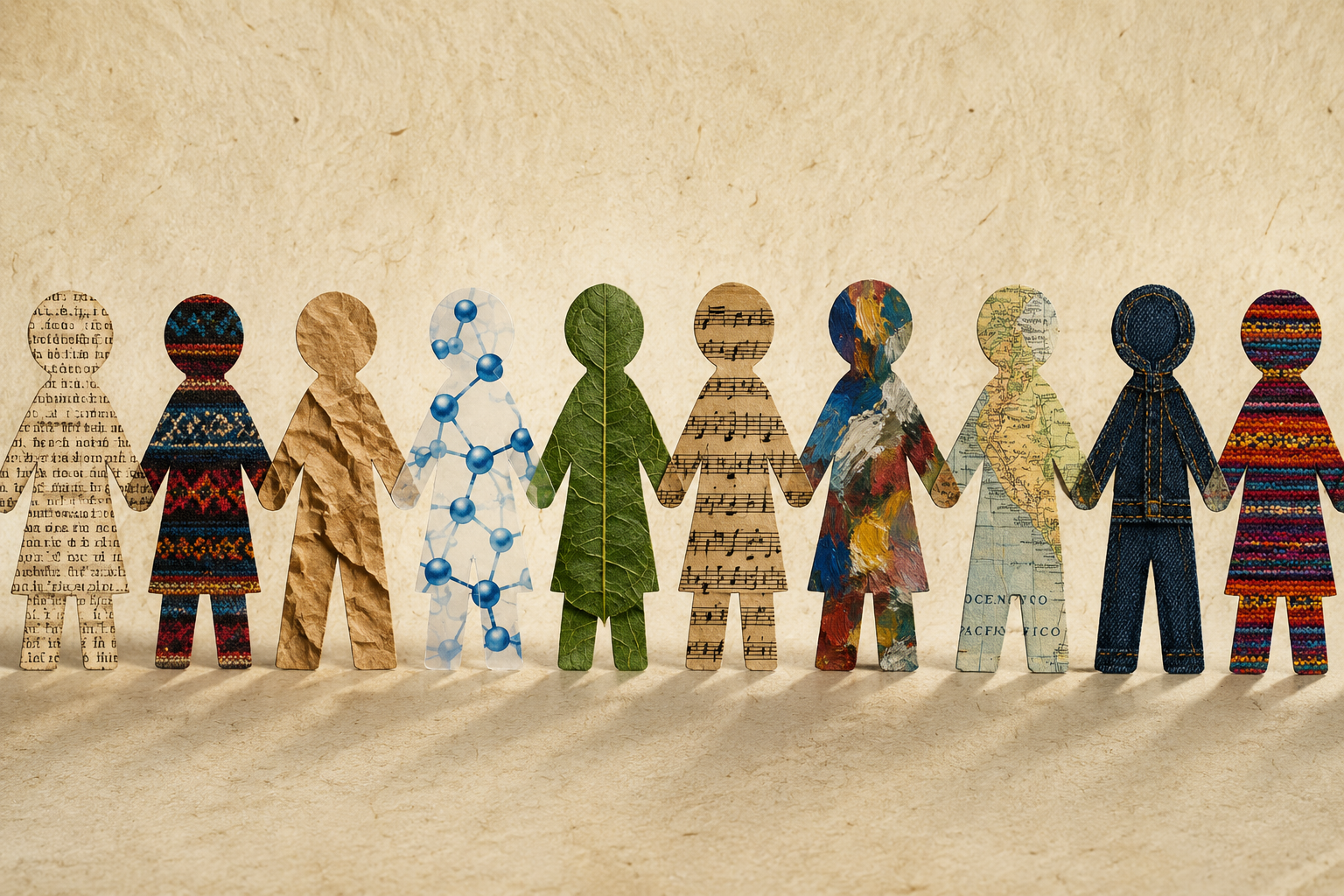
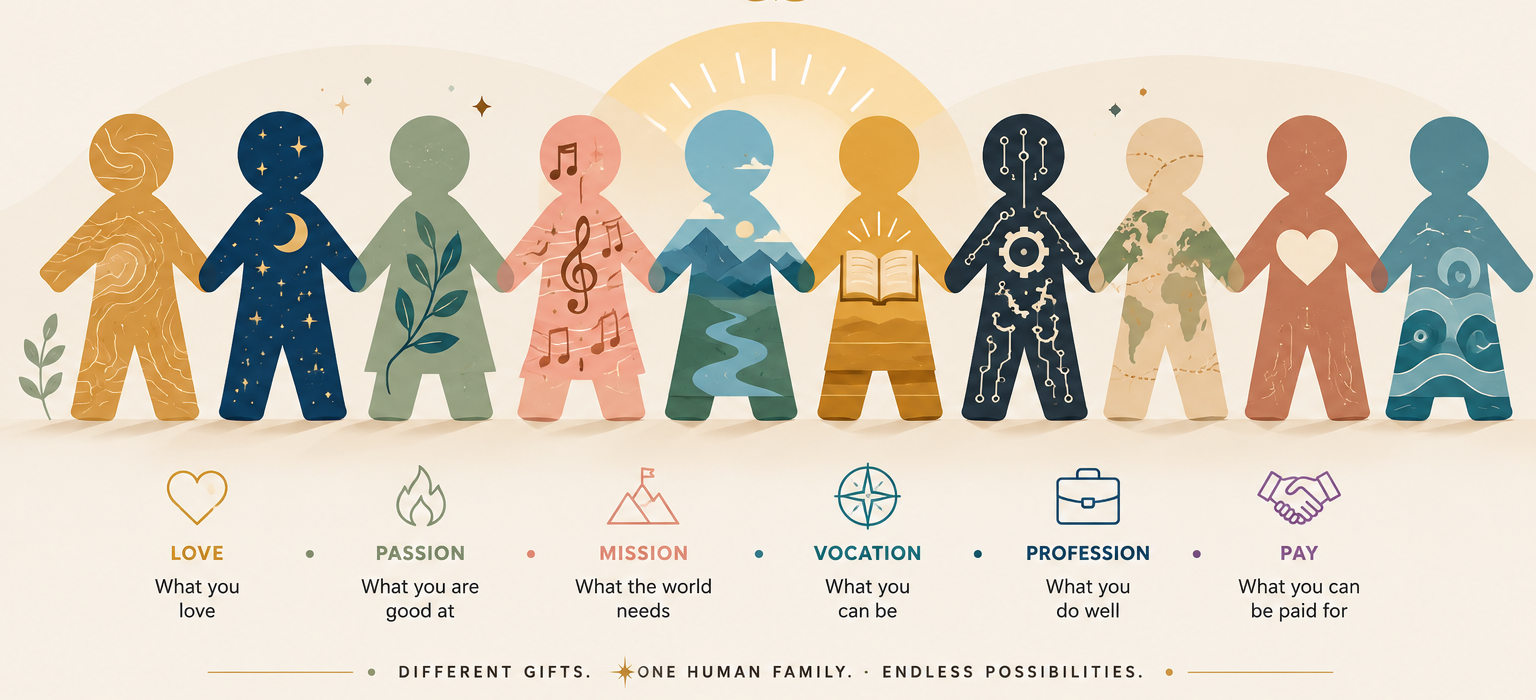
Different gifts · one human familyNo two children take the same path — so the room accumulates instead of repeating.
Why the Screen Is Freedom
A key, not a cage.
We're taught that a screen steals childhood — that a kid on an iPad is a kid
checked out. For the child this system was built to leave behind, the truth is the opposite.
The key, not the cage
The device is often the first thing that ever met them. It reads to the child who
can't decode the words yet. It waits for the one who needs more time. It speaks the language
they came in with. It carries each child's needs quietly — no label, no stigma. It keeps the thread alive
over the summer, between grades, when a family has to move — so learning never resets to zero.
And here is the whole point: the butterfly leaves the screen. The tool exists to send
a child back out into the world — to research the real event, cook the food, interview the elder,
build the thing. A doorway, not a destination.
It frees the teacher, too — from grading the same worksheet twenty-five times — to do the only
work that was ever irreplaceable: to notice, to hold, to love.
The technology is not the point. You are the point. Your presence. Your
noticing. Your ability to steward a room where each child's gift becomes visible and interwoven
with everyone else's. The tool exists to make that possible — not to replace it, but to clear
the space for it. Everything else is just infrastructure.
The device isn't the cage. It's the key.
Access is the freedom.
The World They Return To
A doorway, not a destination.
The screen sends a child outward — to the forest, the real question, the thing they build with their own hands.
The device is often the first thing that ever met them — and the first thing that sends them out.
Every child arrives with a reason for being. The work is to help each one find theirs.
Research the real event. Cook the food. Interview the elder. Build the thing.
From the Founder
I didn't leave the children. I left the system.
I gave thirty years to classrooms. I didn't leave because teaching failed — I left
because the system is built to standardize the very children it should be individualizing, to reward
compliance over thought, and to run on fear. It doesn't work — not for the child in the back row, not
for the teacher running on empty, not for any of us.
It isn't the kids who are failing. It's a machine built on fear, doing exactly what it was
designed to do. But I didn't leave empty-handed — I left with thirty years of watching what
does work, and I'll tell you plainly:
"Everything else is noise. What actually matters is whether kids feel safe enough
to be themselves — to ask what they care about, to serve, to speak truth, to love.
Everything else follows."
— Dr. Niia Bishop · thirty years an educator
Hunter College Elementary & High School · Amherst College (B.A., English & French)
· Institut Catholique & the Sorbonne, Paris · University of Michigan
(M.A. & Ph.D., Comparative Literature; Graduate Certificate, Women's Studies)
Before you speak, you pass what you're about to say through five gates.
Not a rule — a moment of noticing. Meditation, embedded in how you live.
01Is it true?Not "does it feel true." True.
02Is it kind?Kind is not the same as nice.
03Is it necessary?Right now, from me?
04Is it helpful?To them — or only to me?
05Does it improve the silence?If not, the silence wins.
If the answer to most is no, you stay quiet. Not judgment,
not shame — the discovery that between the feeling and the words there is a door, and
you hold it.
In the ecosystemThe AI notices the pause — the moment a child chose the kinder, truer thing. Never scored. Reflected back, so they watch their own patterns change.
The Game — Rethought
Not a scoreboard. A cup.
Gamify it with points and a leaderboard, and some child is instantly at the
bottom, "getting less." That's fear again, wearing a game's clothes. So there is no
leaderboard. There is one cup, and the whole room pours into it.
The room fills it, together.
What raises the water
A true, kind word. A service no one saw. Sitting with
someone who needed a body beside them. Helping another mind flip a thought. Letting
yourself be known. Noticing someone who felt invisible.
Your pour never lowers anyone else's — love isn't scarce. It raises the level for
everyone. You don't beat a classmate. You beat yesterday's water line, together.
And it isn't only how full the cup is.
It's the water itself.
What clouds it
Muddy — unkind words, kept secrets, a withdrawal never repaired
Cold — indifference; the numbness of no one noticing you
Too hot — anger left to boil until it scalds
What clears it
Clear — the truth said gently, a wrong made right
Warm — attention freely given, presence that steadies
Held — care that stays warm without ever burning
So the question is never only how much —
it's is our water clear? Is it warm? Muddy water can settle. Cold water can be
warmed. That clearing, that warming, is the daily work — and it belongs to all of us.
In the ecosystemThe shared water level is something the class can actually see — clarity and warmth made visible, tracked gently, and never ranked.
What We're Building
Not soft. Not naïve. Real.
A place so full of love that fear can't survive in it — where
every practice is aligned with awakening, and the only winning move is to steward more love.